Merchant Cash Advance Debt Guide | Expert Resource

You woke up this morning, checked your bank account, and watched another chunk of money disappear before you could even pour your coffee.
That’s MCA debt. And if you’re reading this, you already know what it feels like — not because someone explained it to you, but because you’re living it.
Merchant cash advance debt is unlike almost any other financial obligation a small business owner can take on. It doesn’t behave like a bank loan. It doesn’t follow the same rules. And it doesn’t give you the breathing room that most traditional creditors would. Understanding exactly what it is — and more importantly, what it isn’t — is the first step toward doing something about it.
This guide is written for business owners who are past the point of wondering if they have a problem. You know you have a problem. What you need now is clarity.
So What Is MCA Debt, Really?

The term “MCA debt” gets thrown around constantly, but it’s worth slowing down for a second to understand what you actually signed.
When you accepted a merchant cash advance, you didn’t technically take out a loan. You sold a portion of your future revenue to a funding company at a discount. They gave you a lump sum upfront — let’s say $50,000 — and in exchange, you agreed to pay back $70,000 or $75,000 by handing over a percentage of your daily sales or a fixed daily ACH withdrawal from your bank account.
Because it’s structured as a purchase of future receivables rather than a loan, it exists outside the regulatory framework that governs traditional lending. There’s no APR disclosure requirement. There are no usury laws capping what a funder can charge. There are no federal consumer protection rules that were written with this product in mind.
That’s not an accident. The MCA industry built itself this way deliberately. And that structure — that legal gray zone — is a big part of why MCA debt can feel so inescapable once you’re in it.
How Does MCA Debt Work on a Day-to-Day Basis?
Most MCA agreements operate through one of two repayment mechanisms:
The first is percentage-based repayment, where the funder takes a fixed percentage of your daily credit card or debit card sales. In theory, this should flex with your revenue — slow days mean smaller payments. In practice, most funders have shifted away from this model because it’s harder to enforce and predict.
The second — and now far more common — is fixed daily ACH withdrawal. Every business day, the funder pulls a predetermined dollar amount directly from your bank account. It doesn’t matter if you had a slow week. It doesn’t matter if you just paid rent. The withdrawal happens automatically, regardless of what’s actually happening in your business.
This is where the cash flow crisis begins. Your revenue fluctuates. Your MCA payment does not. When your daily expenses and MCA withdrawals eat up more than you’re bringing in, you’re not just stressed — you’re technically insolvent.
The True Cost of MCA Debt — Why Factor Rates Are Misleading
One of the most common moments of shock for business owners happens when they sit down and calculate what they actually agreed to pay.
MCA funders don’t quote interest rates. They use something called a factor rate, typically expressed as a decimal like 1.3 or 1.45. The math looks simple: take your funded amount and multiply by the factor rate. If you borrowed $40,000 at a factor rate of 1.35, you owe $54,000.
The problem is that a factor rate looks nothing like an APR until you actually convert it. Because MCA terms are short — often 3 to 12 months — the effective annualized interest rate on that same deal could be anywhere from 60% to over 300%.
Think about that. The same deal that looks like a 35% fee on paper can translate to a 200% annual percentage rate when you account for how fast you’re paying it back.
This isn’t a mistake in the math. It’s a feature of the product. Short terms and high factor rates combine to extract an enormous amount of capital from a business in a very short window.
What Is MCA Stacking — and Why It Makes Everything Worse
Here’s how most business owners end up in the worst MCA situations: they take one advance, the daily payments start to strain cash flow, and to cover the gap, they take a second advance. Then a third. Each new funder takes a position behind the first, which is why this is called stacking.
By the time most business owners reach out for help, they’re not dealing with one MCA. They’re dealing with two, three, or even four simultaneous daily withdrawals. The combined daily drain can be staggering — sometimes $800, $1,200, or $2,000 pulled from the account every single business day.
At that point, the business isn’t really operating anymore. It’s just feeding funders.
What Is Merchant Cash Advance Debt vs. Traditional Business Debt?
This distinction matters because the solutions are different.
With a traditional bank loan or SBA loan, you have a contractual interest rate, a defined repayment term, and legal protections on both sides. If you’re struggling, you can often call the bank and negotiate a modification. Lenders in traditional lending have regulatory incentives to work with borrowers.
MCA funders don’t have those same incentives. They’re not regulated like banks. They’re not subject to the same fair debt collection rules in many cases. And because they structured the deal as a purchase — not a loan — many of the protections you’d normally have don’t apply in the same way.
Additionally, most MCA contracts include a personal guarantee, a confession of judgment clause (in states where it’s still allowed), and a UCC-1 blanket lien filed against all of your business assets. We’ll cover each of those in detail in a moment.
The Personal Guarantee Problem
When you signed your MCA agreement, there’s a strong chance you initialed a personal guarantee clause. This means that if your business can’t pay, the funder can come after you personally — your personal bank accounts, assets, and property.
Unlike a corporate structure that would normally shield your personal finances from business debts, a personal guarantee on an MCA agreement effectively removes that protection for this specific obligation. This is one reason why business owners dealing with heavy MCA debt often feel like they’re one bad week away from a personal financial catastrophe.
What Is a Confession of Judgment in MCA Debt?
The confession of judgment — sometimes called a COJ — is one of the most aggressive legal tools in the MCA industry’s toolkit.
A confession of judgment clause in your MCA contract means that if you default or miss payments, the funder can obtain a court judgment against you without notifying you, without you having a chance to present a defense, and without a traditional court hearing. They simply file paperwork, and the judgment is entered automatically.
Once that judgment is filed, the funder has the legal authority to freeze your bank accounts, garnish payments owed to your business, and move to seize assets. This can happen in a matter of days.
New York, which was once the primary jurisdiction used for COJ filings, now restricts their use in most commercial lending contexts. However, other states still allow them, and older contracts signed before the restriction may still be enforceable depending on the governing law specified in your agreement.
What Is a UCC Lien in the Context of MCA Debt?
Almost every MCA agreement comes with a UCC-1 financing statement filed against your business. This is a public filing — made with your state’s Secretary of State — that declares the funder has a security interest in your business assets.
For most MCA deals, this is filed as a blanket lien, meaning it covers everything: your accounts receivable, your equipment, your inventory, your intellectual property, and even future assets you haven’t acquired yet.
The practical consequences are serious. Any bank or lender that searches your business record will see this filing. They can’t take a first lien position behind an existing blanket filing, which means you’re essentially locked out of traditional financing for as long as the MCA lien is active. Getting a working capital line of credit, an equipment loan, or an SBA loan becomes nearly impossible.
Signs That Your MCA Debt Has Become Unmanageable
Not every business with an MCA is in crisis. But there are clear warning signs that the situation has moved past manageable:
- You’re using personal savings or credit cards to cover business operating expenses because the MCA withdrawals are eating the business account clean.
- Your daily or weekly MCA payments represent more than 25–30% of your gross revenue.
- You’ve taken out more than one MCA, and the combined daily drain is affecting your ability to meet payroll.
- You’ve started missing payments on vendors, suppliers, or other creditors to keep up with MCA withdrawals.
- A funder has reached out threatening legal action, a COJ filing, or has already frozen a bank account.
- You feel like you’re running your business just to pay the funders — not to actually grow or even break even.
If any of those sound familiar, you’re not in a rough patch. You’re in a structural cash flow problem that won’t self-correct without intervention.
What Are Your Options for MCA Debt? — An Overview
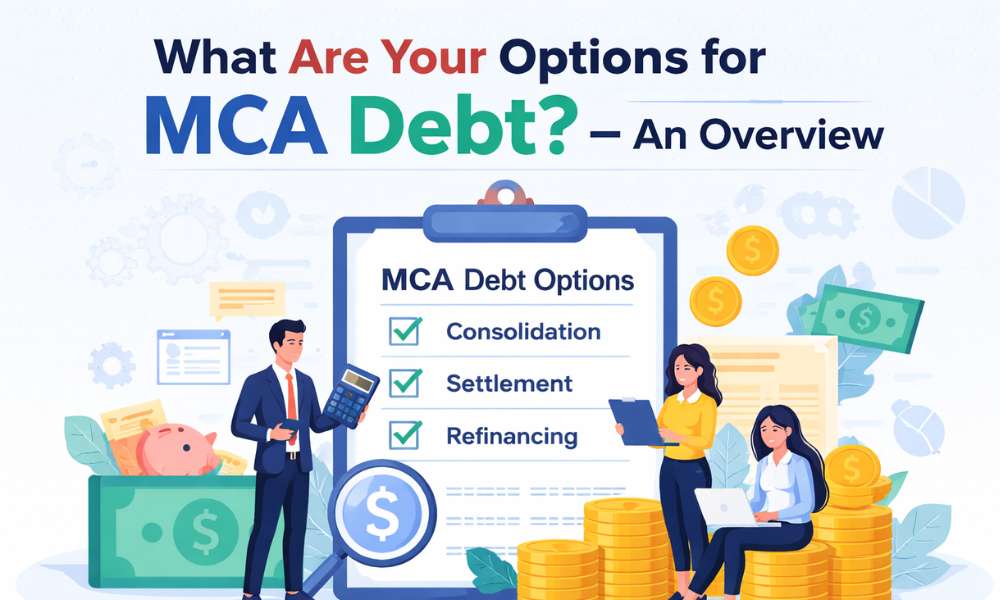
There are four primary pathways that business owners in MCA debt situations typically explore. We’ll cover each of these in dedicated articles, but here’s the honest summary:
MCA debt restructuring focuses on modifying the repayment terms — specifically converting brutal daily payments into a weekly payment that actually leaves working capital in the business. This doesn’t reduce the total amount owed, but it can be the difference between keeping the business open and closing it.
MCA debt settlement involves negotiating a lump-sum payoff for less than the full outstanding balance. This requires having access to some capital or building up reserves over time, but it can result in resolving the debt for significantly less than what’s owed. Results depend heavily on the funder, your specific situation, and the skill of the negotiator.
MCA debt consolidation attempts to roll multiple MCA positions into a single, lower-cost obligation. In practice, this is difficult to execute well because most traditional lenders won’t touch a business with active MCA stacks and UCC blanket liens. What’s sometimes marketed as consolidation is actually just a new MCA product that replaces the old ones.
Bankruptcy — either Chapter 7 or Chapter 11 — is a legal process and a legitimate option in some circumstances. It’s worth understanding as a baseline before evaluating other options, but it comes with significant consequences for the business’s credit and operation. Most business owners exhaust other options first.
How to Get Out of MCA Debt — What Actually Works
The most important thing to understand about getting out of MCA debt is that passive approaches don’t work. Hoping the funders will be patient, waiting for a better revenue month, or juggling payments manually only delays the inevitable and often makes the situation worse.
What does work is taking a structured, documented approach. That means:
First, getting a complete picture of everything you owe. Pull every MCA agreement. Know the funded amount, the remaining balance, the factor rate, the daily payment amount, and the maturity date. Most business owners who seek help don’t have this information organized, which means they’re negotiating blind.
Second, calculating your actual debt-service coverage — the gap between what you’re bringing in and what’s going out to funders — so you understand what a sustainable payment would actually look like.
Third, engaging with funders or working with advisors who understand the MCA industry specifically. General business debt consultants or credit counselors often don’t have the relationships or the knowledge to negotiate these situations effectively.
Fourth, addressing the UCC liens and any legal filings as part of the resolution process. Getting the financial terms settled is only half the equation. The legal instruments — the liens, the judgments, the ACH authorizations — also need to be properly released.
How Daily MCA Payment Reduction Works — and Why It Matters
When people search for daily MCA payment reduction, what they’re really asking is: can I stop the bleeding right now while I figure out a longer-term solution?
The answer, in many cases, is yes — but it requires taking action rather than waiting.
Payment reduction typically happens through one of three mechanisms. Some funders will agree to a temporary forbearance arrangement if you contact them directly and demonstrate hardship before payments start bouncing. Others will agree to a modified payment schedule when approached through a professional intermediary. And in some cases, stopping the ACH withdrawals can be accomplished through a combination of account changes and legal notices — though this is a more aggressive approach with potential consequences.
The key thing to understand is that daily MCA payment reduction is rarely a permanent fix on its own. It buys time. What matters is what you do with that time.
How to Get MCA ACH Withdrawal Help
Many business owners don’t realize they have options when it comes to the automatic ACH withdrawals hitting their accounts. A few things worth knowing:
You do have the right to revoke ACH authorization with your bank, though doing so without a broader strategy can trigger immediate default and escalation from the funder.
Some states have specific rules around what constitutes proper ACH authorization in commercial funding agreements, and there are cases where the authorization wasn’t properly documented.
If a funder is pulling funds incorrectly — pulling more than the agreed amount, pulling after the agreement has been satisfied, or pulling from the wrong account — you have the right to challenge that with your bank and potentially with legal counsel.
These aren’t loopholes. They’re your rights as a business owner. But exercising them requires understanding the process, which is where professional guidance becomes important.
CONCLUSION
MCA debt is one of the most aggressive and disorienting financial situations a small business owner can find themselves in. It moves fast. It doesn’t follow the rules you’d expect. And it can feel like the options are narrowing by the day.
But the situation is almost never as hopeless as it feels at 7am when you’re watching another withdrawal clear.
The business owners who come out the other side of MCA debt — whether through restructuring, settlement, or another path — almost always share one thing in common: they stopped waiting and started getting information. They got clear on what they owed, what their rights were, and what the actual options looked like.
This article is a starting point. The next step is yours.
Drowning in Daily Payments?
Let our legal experts step in, stop the drafts, and restructure your debt to an affordable rate.
Get Free Consultation